What is Ecommerce? A Simple Guide to a Complicated Industry
Here's your ultimate guide to ecommerce
 Meg Nanson


In this article, we'll teach you everything you need to know about ecommerce. We'll cover what ecommerce is, the different types of ecommerce transactions and how they work, important industry trends and statistics, break down all of the parts needed for an ecommerce site to be profitable, and tell you who to talk to about things like supply and shipping. However, before we dive into any of that, let's define what ecommerce is:
Ecommerce refers to any commercial transaction (sales or purchases) conducted online.
You may notice that this definition seems broad - that's because the industry itself is massive, with plenty of niches and opportunities for clever entrepreneurs.
Whether you're planning to start your own ecommerce store, just launched your own business, or have been selling online since , this guide is here to help you take an simplified, organized look at this sprawling, multifaceted industry. By the time you've finished reading, you'll know what ecommerce is and how it works, have a sense of important industry trends and statistics, be able to detail the steps needed to take a product from an idea to physical items in the hands of customers, know who to talk to about things like supply and shipping, and much more.
The guide will have two main parts: The Ecommerce Industry and The Anatomy of an Ecommerce Website. In The Ecommerce Industry, we’ll zoom out and look at the ecommerce space as a whole, charting its history and growth. We’ll also detail different ecommerce business models and introduce you to key players in the ecommerce industry. If you’re thinking about opening up an ecommerce store and you’re not quite sure where you fit in, don’t skip this section: understanding the larger machinery at work and the available options within that will help you design a business that fits your goals.
Then we’ll zoom in for The Anatomy of an Ecommerce Website, which will provide a start-to-finish look at building a successful ecommerce website while highlighting tips and best practices along the way. From planning your finances to preparing for growth, every stage of the ecommerce business will be covered. By the end you’ll have a deeper understanding of how ecommerce fits into your life. Maybe that means you leave feeling inspired to start your own store, or maybe it just means you’ll finally have some talking points when your friends bring up their businesses. Let’s get started!
Part 1: The Ecommerce Industry
What is Ecommerce?
We've already covered that ecommerce is any transaction — a purchase or a sale — that happens online, and agreed that this definition is too vague to be useful. It's much more useful to identify the different types of ecommerce transactions that occur in real life and break each one down individually:
The Different Types of Ecommerce
Ecommerce Business Models
- Business to Business (B2B): As we mentioned earlier, B2B ecommerce companies - companies that sell products, software, services or supplies - are an incredibly popular ecommerce model. Not only do they dominate the industry today, but they were also the first businesses to jump on the ecommerce train in the first place, opening online pathways for transaction long before B2C came to market.
For B2B ecommerce shops, the digital realm is just one option out of many possible revenue channels, or a convenient way to facilitate interaction with existing customers.
B2B businesses are not interested in attracting a broad customer base - their products are typically only useful to people with specific jobs, skills, or training, which makes it very important that they target their customers carefully. Organically, they target very specific keyword variants, while also relying on other channels like phone or in-person networking to nurture their sales. For B2B ecommerce shops, the digital realm is just one option out of many possible revenue channels, or a convenient way to facilitate interaction with existing customers. For B2C ecommerce stores, the online world is much more likely to be everything.
-
Business to Consumer (B2C): Also called retail ecommerce, this encapsulates the entire realm of digital shopping. The B2C model rewards both traffic volume and conversion rate, which means a cornerstone of the B2C game is attraction (marketing) and conversion (design). In other words, they’re all about customer appeal.
-
Consumer to Consumer (C2C) These sites don't actually sell their own products, but instead allow customers to sell products to one another (taking a small piece of the profit). Online marketplaces and auction platforms like eBay are C2C platforms. If you're a small business, it's unlikely that you'd start a C2C platform. Since these platforms rely on making small amounts (sometimes less than a cent) from each transaction, these sites rely on high customer volume to succeed.
Ecommerce Product and Supply Types
-
Physical vs digital products: If you buy a pair of shoes online, there’s no getting around the fact that after you hit the “check out” button, they’re not going to magically appear. Instead, you’re going to have to wait for the shoes to be shipped and physically in your hands (er, on your feet) before you can enjoy them. If you want to rent a movie or purchase an ebook online, however, you can have access to it as as soon as you pay. A company that sells digital products, then, has eliminated some major logistical and financial hurdles. It’s not a free ride, though; whether it’s a song, a piece of software, or a guide, there’s no getting around the considerable amount of time it will take to create or secure the rights to a conversion-friendly resource in the first place.
-
Make vs manufacture and wholesale vs dropshipping: What a mouthful! If you’re selling physical products, these are your four procurement options. Let’s take a quick look at each one:
-
Make: You could make your products yourself. Many businesses start with a skill, hobby or passion.
-
Manufacture: For makers who are overwhelmed with work and need to scale, or for non-makers with an idea and a prototype, you can find a manufacturer. Using your exact design, recipe, or instructions, a manufacturer will make your product for you. It’s an extremely efficient way to continue selling truly one-of-a-kind items and have full control over your products; it’s also the most expensive option on the list. As a rule of thumb, the more customization you require (up to and including a fully custom-manufactured product), the more you’re going to pay.
-
Wholesale: For a more affordable cost, you can buy large quantities of a product at a wholesale price (which is usually around half of the suggested retail price) and resell the products with a markup. You’ll likely have to hit a minimum and will need a place to store the inventory, but buying wholesale generally involves less risk and expense than having a product manufactured. The drawback is you’ll no longer be selling a unique product.
-
Dropshipping: For the lowest amount of risk and up-front cost, there’s dropshipping. This involves selling a product on your website that is stored and shipped by a third party (often the manufacturer). The pros? No warehouse storage, no risk of being stuck with inventory that won’t move, and no paying for the product until it sells. The cons? Your cut of the pie will be considerably smaller than the margins you’d make with any of the other models, given that your third party vendor is doing a large portion of the work. And because the barrier to entry is so low, you’re likely to be facing steep competition from other dropshippers. If you don’t do your homework, you’ll be selling the exact same products as everybody else.
-
Important Players in the Ecommerce Industry
A couple of the models above have already touched on some other key players in the world of ecommerce: manufacturers, wholesalers and dropshippers. When you open an ecommerce store, you’re going to start crossing paths with tons of different businesses and supporting players in the industry. Here are just a few of them:
Planning
- Accountants
- Legal advisors
- Business consultants
Funding
- Banks
- Grant reviewers
- Investors
- Angel investors
- Crowdfunding platforms (and their user base)
Procurement
- Manufacturers
- Wholesalers
- Dropshippers
- Supply chain managers
- Vendors for packaging, labels, and printing
Website Management
- Hosting platforms
- Ecommerce platforms
- Web designers
- Web developers
- Payment processors
- Third-party vendors, developers and integrations
- CRM (Customer Resource Management) platforms
Marketing
- Social media platforms
- Advertising platforms
- Affiliate marketing platforms
- Digital marketing agencies
- Email marketing platforms
- Bloggers and reporters
- Social media influencers
Shipping
- Shipping services (UPS, USPS, FedEX, DHL)
- Shipping software vendors
- Packing supply vendors
- Order fulfillment centers
A Brief History of Ecommerce
The history of ecommerce stretches back to the early 1980’s when a small handful of B2B companies began conducting transactions with their customers online. However, the pre-1990 internet was limited to closed networks and the transmission of secure “packet systems” within those networks, making online communication and exchange inaccessible (and pretty boring) for the general public.
Netscape released the first SSL-encrypted browser, allowing secure transactions to take place; and shortly thereafter, the first major online marketplace, NetMarket, emerged.
In 1990, a man named Tim-Berners Lee wrote the first web browser, WorldWideWeb, and created the first truly connected, accessible public network. Slowly, computers became a common fixture in “average” households everywhere. You might remember your own first computer, and it’s highly likely that the year was in the ballpark of 1994. That’s when Netscape released the first SSL-encrypted browser, allowing secure transactions to take place; and shortly thereafter, the first major online marketplace, NetMarket, emerged. Also in 1994, a man bought a Sting CD from NetMarket for $12.48 and went down in history as the world’s first B2C ecommerce customer. From there, online shopping picked up steam with the introduction of titans EBay and Amazon in 1995, and the ecommerce industry has been on a steady path of growth ever since.
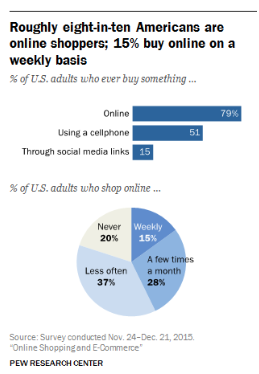
In fact, the growth statistics for the industry today provide staggering insight into just how far ecommerce has come. As of 2015, 79% of Americans were shopping online every single week.
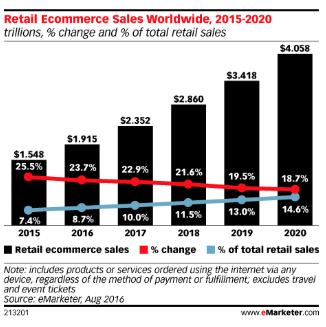
And today, ecommerce is the fastest-growing retail sector, with a rate of 23% growth year over year.
And though it may seem ubiquitous enough today, there’s still plenty of room for ecommerce to grow — to the tune of more than $4 trillion by the year 2020.
Some of this growth does come from the usual suspects — young people are more connected than ever and prefer shopping online to brick-and-mortar shopping, and the audience of people who grew up connected is ever-growing - but there are also some surprise players. One of the biggest? B2B (Business to Business) ecommerce shops, which in 2017 [dominated](https://www.statista.com/study/44442/statista-report-b2b-e-commerce/) the industry with $7.7 trillion in revenue, compared to B2C’s $2.3 trillion.
We’ll be diving into the B2B model later to take a look at the factors that make it such a prominent force in ecommerce.
The Advantages and Disadvantages of Ecommerce
With such promising growth and more accessibility than ever, ecommerce has become a popular choice for fledgling entrepreneurs and business veterans alike. But that doesn’t necessarily mean it’s the perfect model for you. To help you decide, here’s a list of the biggest advantages and disadvantages of ecommerce:
Advantages:
-
Lower startup costs. This isn’t true across the board, but if you’re short on capital, ecommerce is a smart way to go. Some of the major costs of running a brick and mortar, like rent and utilities, will be drastically reduced (and if you use a model like dropshipping, they can even be eliminated completely).
-
Automated payment processing and inventory management. This reduces logistical burdens and can reduce the amount of staff you’ll need to hire
Ecommerce lets you start as small and independently as you’d like.
-
You can start solo. Not ready to hire any staff at all? Ecommerce lets you start as small and independently as you’d like. If you ran a brick-and-mortar solo, you’d either exhaust yourself or disappoint your customers by closing up every time you need to take a sick day or vacation.
-
You can find your niche. So you want to open a store called Everything Sloth, selling nothing but products that feature your favorite adorable, slow-footed animal? As a local brick-and-mortar, this one might wear through its foot traffic pretty quickly; but on the internet, you can find your people and build a sloth-loving, Utopian community with a click.
-
You’re open 24/7. If a customer wants to make a purchase at 3am, they can go for it. Even when you’re not available for customer service, the availability of the transaction never wanes.
Disadvantages:
-
You’re less likely to do your homework. Because some of the obvious expenses and logistical hurdles have been knocked down, novice ecommerce store owners often underestimate the amount of planning, time and money it will take to successfully launch a business. With a brick and mortar business, the reality of renting retail space forces people to get their ducks in a row prior to launching their business.
-
Competition is fierce. This is the flip side of the “find your niche” benefit. Being online allows you to speak to a network of people all over the world who’d never walk past a local shop in your small hometown. On the other hand, it also means you’re competing with fellow ecommerce stores, all over the world, who’d never open up shop next door to you locally.
-
You’ll need a different type of team. You might be saving money on rent and retail staff, but as you grow you’ll find yourself hiring staff to fill positions that aren’t necessary at a brick and mortar: web developers, designers, digital marketers, and more.
-
24/7 availability means 24/7 customer requests. With ecommerce, your customer service communication needs to be as organized and streamlined as possible. A customer might not be expecting a live response at 3am, but if you wait 48 hours to get back to them, they’ve probably already started looking elsewhere. Since customer service interactions happen in real-time at a brick and mortar, you’re less likely to let requests pile up.
Part 2: The Ecommerce Website
The Anatomy of an Ecommerce Website
Like people, ecommerce websites are unique in their appearance and personality but otherwise have the same DNA as all the other ecommerce websites. We can take a look at any given ecommerce website and expect to spot the same building blocks across the board:
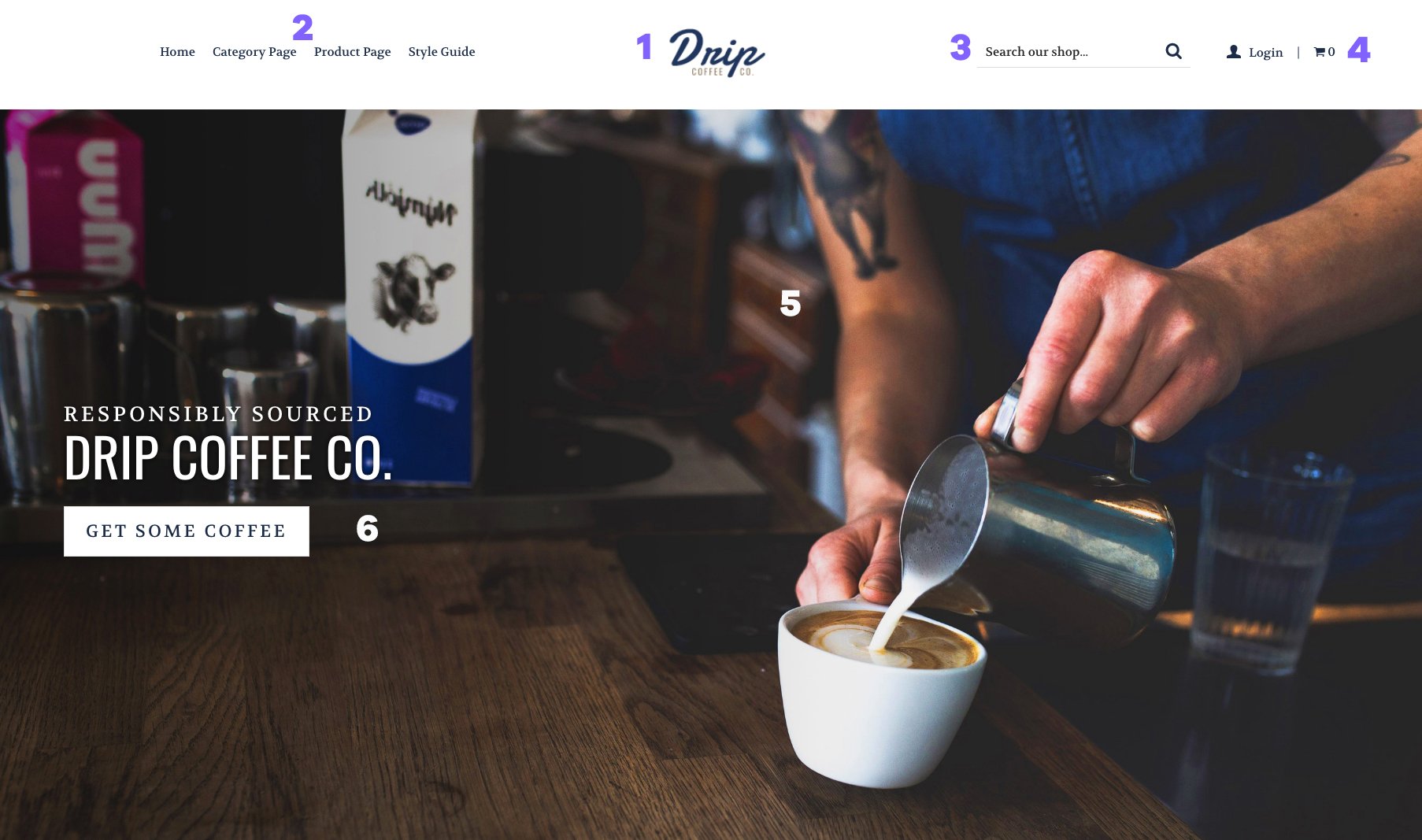
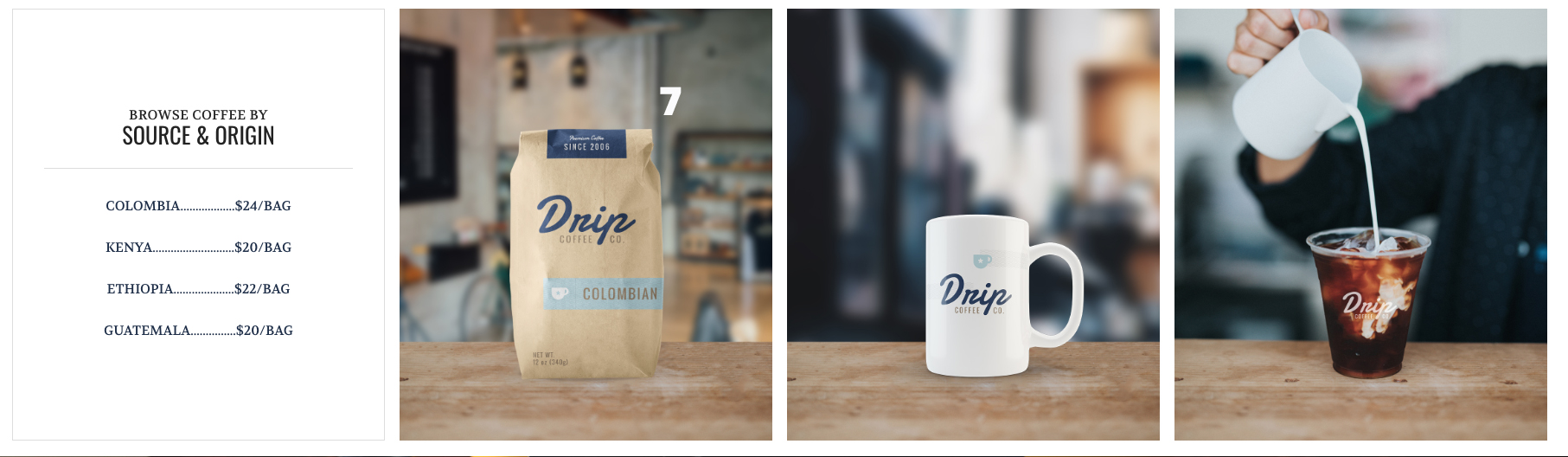
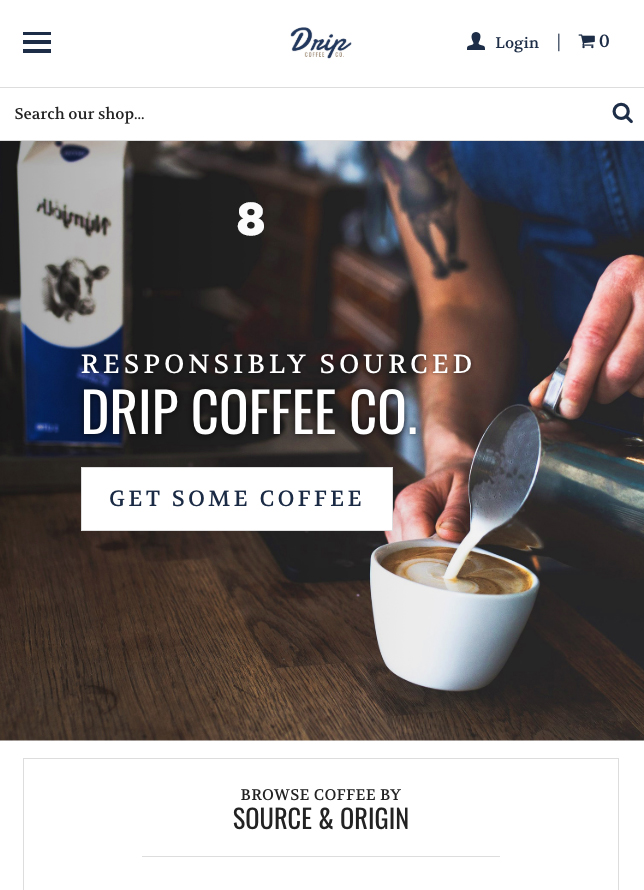
1. A site-wide name and logo: This is technically optional, but people have come to expect seeing a name and logo at the top of every page, which is usually hyperlinked back to the home page so they can navigate home with a click.
2. Navigation: Most ecommerce sites are far more than a single page, so they need a roadmap to help their visitors move through the site quickly and logically.
3. In-site search (optional): This is a very common feature in ecommerce shops, used to help visitors find the products they want without browsing through the navigation.
4. A site-wide shopping cart: Any time you add a product to the cart, the number on the cart will update accordingly to help you keep track. When you’re ready to check out, you can click on it any time to get directly to checkout, no matter where in the site you are.
5. A hero graphic (optional): This is a very common design feature that lets you visually introduce the shop and announce promotions.
6. Prominent CTAs (Calls to Action): These encourage visitors to take the next step, whether it’s perusing a new collection, signing up for a newsletter, or adding a product to their cart. Your site has “mini conversions” on the path to a full conversion (a purchase), and if you’re having a conversion issue, it’s helpful to assess the mini conversions first to see where people are dropping off. Not sure where your mini conversions are? Take a look at your CTAs. Whenever someone performs the action you’re asking them to take, they’re likely completing a mini conversion.
7. Featured information or products on the home page (optional)
8. Responsive design (optional but strongly encouraged): This means your site isn’t just viewable on a mobile device; it adapts to it. That means priority information will get highlighted and content will be an appropriate size without requiring excessive scrolling.
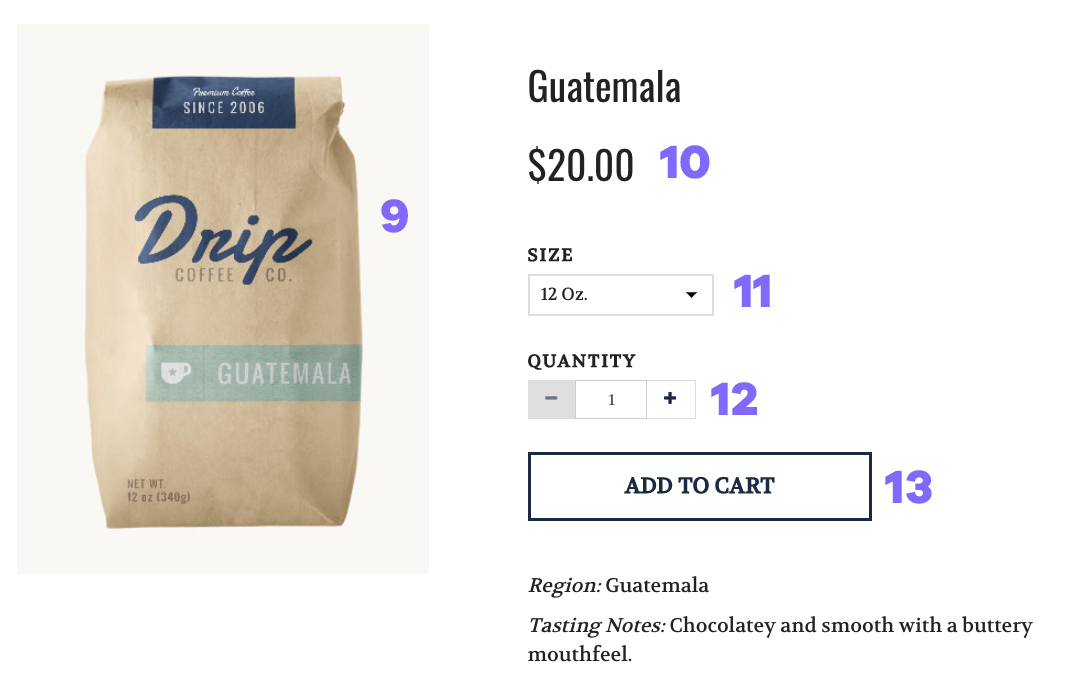
9. Product images: Technically optional, but strongly encouraged
10. Prominent “need-to-know” info about each product: You can expect every product page to share the price along with other need-to-know info, like:
11. Size and
12. Quantity directly before the “Add to Cart” button. In a separate section, there’s usually a longer product description.
13. An “add to cart” button: Anywhere there’s a product, it will accompany a CTA that lets you add the product to your shopping cart.
14. A site-wide footer link with shop policies and logistical information: If people have questions about shipping, returns, terms and conditions, or other store policies, they’ll look to the footer
15. Site-wide links to your social media accounts (optional): These are most common on the header or footer.
Not pictured: an https address: Any site that takes payment information should be 100% secured. Looking for an https (as opposed to an http) in the address field is your first and fastest way to check. There’s also usually proof of SSL encryption, like a badge or lock graphic.
No matter the ecommerce site, you can expect to see those features; everything else is just gravy. Of course, the gravy is the part that can turn your business into a standout success or send it plummeting to the customer-free doldrums. Let’s take a look at what you can do to make sure yours is one of the success stories.
Your Ecommerce Success Checklist
Despite how diverse ecommerce sites are, the successful ones by and large follow the same set of best practices. As you build your ecommerce website, make sure you’re checking off these boxes:
Design
-
My website uses clean, high-resolution imagery in all of the appropriate places. Header graphics, product photos and other graphics are unique, tell the story of my brand, and render well on both desktop and mobile.
-
My website (or website theme/template) is responsive, fluidly adapting to different screen sizes without obscuring or removing priority information
-
My website uses a clear, consistent family of fonts that is readable on both desktop and mobile, and the colors are not high-contrast or hard on the eyes (this is also an accessibility issue)
-
Headers, subheaders and body copy are all properly delineated by size and use the appropriate HTML tags
-
My website uses a consistent color palette that helps tell the story of my brand
-
My CTAs visibly pop, but not in a way that interferes with the rest of the design
UX
-
My website doesn’t contain heavy Flash animation, autoplay videos or bombard the user with popups and splash pages
-
My website has a clear, logical navigation
-
There is a way to navigate home on every page via a hyperlinked site name or logo
-
My website doesn’t ask users to enter their information before it’s necessary
-
My website loads quickly
-
My images are properly compressed and aren’t uploaded in sizes that render poorly or drag down the site’s load time
-
The information my user needs is always where they expect to find it: when they need to know the price of an item, check out, or see my store’s shipping policy, they know how to do it
-
When they aren’t browsing, my visitors can find most of what they want in three clicks or less
-
Navigation assists like a search bar, hyperlinks, and breadcrumbs are used effectively. All links work. All social media icons link to the right places.
-
My website is free from errors. If a user does hit a 404 error, they are notified of it and given a way to get back home
-
I’ve walked through my website as a prospective user and have made test purchases
Content
-
My content tells the story it should be telling in the appropriate places: my home page sells the shop, and product pages sell the products, for example
-
All of my content is unique
-
My content has a voice and tone that is consistent with the brand
-
My content highlights the appropriate information, and elements like bullets and paragraphs are used as organizational tools
-
My content is written in HTML text format, not uploaded as pdfs or images, and not hidden in Javascript
Other
-
My website is SSL-encrypted and the https protocol is used
-
Google Analytics is installed and I have a plan in
place for measuring my results
How to Plan and Start an Ecommerce Store
Do you think that checklist is doable? Are you excited to try? Sounds like you’re ready to start your ecommerce store! For an in-depth look at the process, check out How to Start an Online Store. If you’re just looking for a roadmap, here’s a big-picture overview of the the steps you’ll take on your path to a booming ecommerce business:
-
Decide what you’re going to sell. Even if you have a specific product or industry in mind, this is often the most difficult place to start. For help, check out our detailed guide, Picking Products to Sell Online.
-
Choose your model. B2B or B2C? Make, manufacture, or dropship? Answering these questions will give you a better understanding of the budget you’ll need and the amount of time it will take to ramp up.
You may not have the most original product ideas in the world but if you have a unique niche audience and a compelling brand, you can still run a successful business
- Determine your audience and brand. Who is your target audience? Get to know them well. This should come during or directly after the “what should I sell” phase, because it’s the other half of settling on a marketable business idea. You may not have the most original product ideas in the world but if you have a unique niche audience and a compelling brand, you can still run a successful business. On the flip side, you might have discovered an amazing product or business opportunity but if you don’t know who you’re marketing to, it won’t gain traction.
As you learn more about your audience, you can develop your brand identity, focusing on the shared values between your brand and your audience.
-
Name your business. Understanding your brand beforehand might make choosing your name a little easier, too. However, for most business owners, deciding on a name will never be a walk in the park. Don’t let yourself get stuck on this step! Do make sure to Google the name, run a trademark search, and check for social media handles. Once you’ve found a winner, don’t wait to secure the domain name, social handles, and any necessary trademarks.
-
Create a start-up budget. How much money will it take to see your dream through? If you’re planning on working on your ecommerce store full-time, do you have enough money saved up so that you’re not relying on income from the shop for at least six months (and hopefully longer)? Include money for marketing, paying for large quantities of up-front costs, shipping supplies, and everything else it will take to make your shop successful. And don’t forget to set an hourly rate for yourself!
-
Create a scale-up budget. This one is so important, but it’s something that way too many people forget about. A lot of people figure out how much they’re going to need to launch and manage their store for awhile, and then they call their budgeting complete. However, remember that in a perfect world, you’re going to hit a point at which you’re so flooded with orders that you will no longer be able to do it all yourself. Remember that hourly rate you set for yourself? That exists to offset some of the burden that you’ll feel when it’s time to hire employees — your margins will have already factored some of the cost in.
Don’t just think, “If I’m selling that much, all the extra profits will pay for my employees.” Validate it. Run the numbers and make sure everything checks out on paper: are your margins high enough? Does the profit get re-absorbed by other parts of the business? Will you always have ample money in your account to pay your employees on a regular schedule, along with the overhead that will be going to taxes and HR? Being short on cash flow is one of the biggest business-killers that exists, so prepare for as much as you can. If you’ll need a loan or line of credit, factor that in, too.
It can’t hurt to hire an accountant for consulting on how to get your shop’s finances off on the right foot.
-
Get your ducks in a row. Set up an LLC and and business bank account, using only your business bank account to pay for everything related to the business. This will make things a little easier on you come tax season. It can’t hurt to hire an accountant for consulting on how to get your shop’s finances off on the right foot. While you’re at it, consider paying for a couple hours with a lawyer or business consultant to make sure you’ve crossed your i’s and dotted your t’s, especially if you’re entering a highly-regulated industry. Even if you aren’t, you might be surprised by some of the regulations you’ll be looking at and the types of insurance you’ll need.
-
Choose a platform. We’re almost out of the planning phase now! The only thing left to do before you start building is figure out where you’re going to open up shop. An ecommerce platform will make the next part a lot easier by streamlining the process and providing you with the exact tools you’ll need to build and market your store, accept payments, and manage shipping and inventory. We’re going to plug Volusion for this one, and it’s not just because you thought we would. Volusion has some of the best out-of-box functionality and customer support in the industry and it’s built to scale. Plus, if you choose to outsource design or marketing later, you’ll be able to turn to Volusion’s expert in-house team. These are people who don’t just know their field; they also know the Volusion platform like the back of their hand.
-
Build your website. This topic is too huge to cover in a single bullet point, but the Volusion blog has a wealth of resources about everything from DIY photography to conversion optimization. Study up, and then grab your website checklist and start building. When you’ve hit MVP status (Minimum Viable Product - it means your site is good enough if it’s not yet your dream website) then it’s time to launch. But not without testing first! Run through the entire website yourself, make test purchases, and invite some “beta users” to give their feedback.
-
Launch! And then immediately start optimizing. Watch how users behave on your website. Know where they’re dropping off, where they’re converting, which products are the most popular, and which products need help. Your website will never be complete. Consider it a constant work in progress and pay careful attention to your audience’s needs so that you can modify the site accordingly. In addition to optimizing the site, you’ll want to constantly feed the marketing machine: via great content, ads, social media, SEO, product reviews, Shopping Feeds, PR, merchandising, and more. This won’t just help your products sell; it will also provide you with valuable data and user feedback.
From there, you’ll be learning how to hit your stride and taking on the busy task of running a full-fledged ecommerce business.
Put Your Ecommerce Knowledge to Use
And that’s all there is! Ecommerce is easy, right?! Kidding. Opening an ecommerce store takes tons of hard work, planning, resources, time, and laser-sharp focus. The good news is, resources are more available than ever, and platforms like Volusion can put a significant dent in the amount of time you’ll spend building and managing your shop. So, what are you waiting for? Take the plunge and start planning your dream business today!
What questions do you have about ecommerse? Let us know in the comments!