Employees or Freelancers: Which Type of Worker is Right for Your Ecommerce Store?
Unsure whether to hire an employee or freelancer for your business? Check out our handy guide
 Kiera Abbamonte


When it comes time to bring on help for your ecommerce store, business owners must choose between hiring an employee or working with a freelancer.
With 57 million people in the US alone working as freelancers this year, there’s never been a larger pool of talented independent contractors for ecommerce businesses to choose from. The gig economy is booming, but it isn’t the only option for small business owners—and a freelancer may not be the right choice for every situation.
So how do you decide whether to hire full-time help or contract individual projects out? There’s no one-size-fits-all answer, so it really comes down to understanding your business’ needs and what it means to collaborate with each type of worker. From there, you can make the smartest decision for your online store—and start benefiting from that extra help sooner.
In this guide, we lay out the four steps ecommerce owners must take to hire the right kind of worker for their store.
Step 1: How to Know if You’re Ready to Hire
Ultimately, the decision to hire either a freelancer or an employee hinges on your business’ needs and available resources. Analyzing those needs starts before you even make the decision to hire anyone by ensuring that you’re really ready to bring a new member to the team in the first place.
When you’re feeling overworked or handling tasks you don’t enjoy, it’s easy to rush straight to the idea of hiring someone else to help. But hiring, whether an employee or independent contractor, requires much more thought.
As a foundation, you need to ask yourself these five questions:
- Are there skills or experiences you’re lacking? Maybe you need a supply chain expert to help you expand production. You might need an email marketer to help boost customer loyalty and squeeze more value out of your existing client base. If there are roles you need filled that you don’t know how to do, that’s a good sign you may be ready to hire.
- Are they holding your business back? Ecommerce store owners are human, which means they can’t do it all. However, there’s an important distinction to be made here: does your business need that type of skill or experience? Are you being held back without it?
- Will filling this role actually help you grow? Similarly, it’s important to have a clear vision for how hiring someone to fill this role will lead to business growth. How will this worker contribute to the bottom line? What’s the financial benefit of having them handle it instead of you?
- Are there jobs you can do that eat up time better spent elsewhere? There are plenty of tasks you probably can do in a day, but they may not be the most valuable use of your time. If you’re spending more time working in the business rather than on it, that’s another good sign it might be time to offload that work to someone else.
- Can you afford to hire someone? Even if you answered the first four questions affirmatively, there’s still the question of practicality. Can you actually afford to pay someone else right now? If not, it’s probably time to delay hiring for the time being.
Step 2: Understand the Differences Between Freelancers and Employees
Now that you know you need to hire help, the next step is to build a well-rounded understanding of what it means to hire an employee and a freelancer. From pros and cons to costs to tax and other considerations, the only way to make the best decision for your ecommerce store is to get the full picture before you decide anything.
Freelancers vs. Employees: Pros and Cons of Each
We’ll go more in depth in the next few sections, but here’s a summary of the basics of each type of worker to get you thinking:
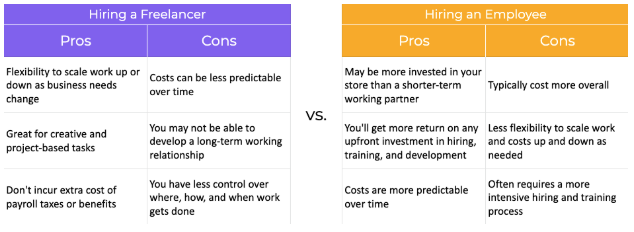
To break it down, the biggest benefits to working with a freelancer include the flexibility to scale work up or down as needed and the lack of additional costs and complexities like payroll taxes and benefits.
The chief advantages of hiring an employee include more predictable costs over the long term and a longer-term, more committed working relationship.
Those basic benefits translate into real-life situations a little differently. Some kinds of work tend to be more creative and project-based—those are the roles that often make sense for freelancers. Other work requires a deep, long-term understanding of your business, customers, and ongoing work—this is the kind of work that is better for a full-time employee.
For example, some of the most common roles freelancers are hired to fill include:
- Accounting and finance
- Administrative work
- Software development
- Customer service
- Writing
In the ecommerce world, that might look like a virtual assistant hired to manage your inbox or a freelance writer hired to fill your blog with content.
On the flipside, jobs like new product development or personalized outreach to customers may be better handled by an employee with a deeper understanding of your brand and customers.
Other Considerations to Think About
When it comes to choosing an employee or a freelancer, there’s more to consider than costs and taxes. At the end of the day, you need to think about your store and its needs—that’s the ultimate decision criteria.
Along that line of thinking, here are a few other questions to think about:
- Are your needs seasonal or constant? If you only need help during the busy holiday time, it may not make sense to hire a full-time employee for the whole year.
- Do you need someone for 40 hours every week? If your needs aren’t seasonal, consider if you really have 40 hours per week worth of extra work. If not, you might be better off considering a freelancer or part-time employee instead.
- Does the work require confidential or inside information? Most good freelancers are trustworthy and happy to sign a Non-Disclosure Agreement (NDA) to protect your store’s sensitive information. That said, many prefer to hire internal employees when the work requires dealing with confidential or inside information.
- Does everything you need often come in one package? Maybe you have enough work for a full-time employee, but can one person do all that work? If you can’t hire one person who’s an expert in everything you need done, you might be better off working with multiple freelancers instead.
- How much control do you need over the work process? With freelancers, you can really only control the end-product. If you need or want to dictate where, when, and how that product comes to be, an employee is the better option.
A Note on Blurring the Line Between Freelancer and Employee
We’ve talked a lot about the differences between employees and freelancers, but it’s still easy to wonder what the big deal is. It’s important to understand the difference because the classification of your workers impacts your taxes, and the IRS is very strict about who is an employee and who is a freelancer.
If you’re ever unsure of whether a worker is an employee or contractor, you can file Form SS-8 with the IRS, and they’ll give you an official determination.
Step 3: Compare the Relative Costs of Hiring a Freelancer vs. Employee
One of the biggest considerations for small business owners deciding between freelancers and employees is cost. It goes right to the heart of our fifth question above: what can you afford?
It can be hard to compare freelancers and employees to one another. Costs vary based on the job, industry, desired experience, and more. Not to mention that an employee costs more than just their salary.
In general, your costs for hiring a freelancer include their hourly rate or project-based fee—and that’s it. For example, if you and a freelancer agree on $50 an hour and you need 10 hours of work, your cost is $500.
When you hire an employee, you pay their salary, but you also incur additional costs that can include:
- Bonuses, commission, and other compensation
- Required benefits (like health insurance, 401(k) matching, overtime pay, etc.) and additional perks (educational stipends, commuter benefits, etc.)
- Job training
- Payroll taxes
In fact, MIT estimates that the true cost of hiring an employee is anywhere from 1.25-1.4 times higher than their designated salary. So if you hire a full-time administrative assistant for $45,000 per year, you can expect to pay between $56,250 and $63,000 total for that employee.
That said, freelancers are most often small business owners themselves, and they’re paying for benefits and self-employment taxes out of their own pockets. That means you can expect to pay an hourly rate that’s technically higher than what you’d pay an employee.
Tax Considerations to Keep in Mind
We touched on this briefly above, but one of the key considerations to keep in mind is taxes. That’s because the government and IRS treat employees and independent contractors very differently for tax purposes.
When you hire an employee, you’re required to pay payroll taxes on every dollar they earn. You’re also responsible for withholding the employee’s share of certain taxes (like FICA, social security, and income taxes) and depositing that money with the proper tax authorities.
In addition to paying and withholding payroll taxes, you’re also responsible for collecting and distributing different tax forms depending on whether a worker is a freelancer or employee. For employees, you need to collect completed I-9 and W-4 forms and provide annual W-2 forms. For freelancers, you need to collect a completed W-9 form and furnish 1099-MISC forms annually to any freelancer you paid $600 or more throughout the prior year.
In other words, payroll taxes add both cost and complexity to your ecommerce store, so they’re an important consideration for deciding between employees and freelancers.
Step 4: Get Started With Hiring an Employee or Freelancer
Once you’ve made a decision on hiring an employee or a freelancer, it’s time to get started with the hiring process. We could write a book about hiring, so we’ll stick to the first few steps to help you begin.
Think About and Assess Your Needs for the Role
In large part, you’ve already done this step—it’s how you made the choice to hire either an employee or a freelancer. For our purposes today, now’s the time to bring all of those needs and considerations together. Write down:
- The individual tasks you need done
- The goals those projects will work toward
- The skills and experience needed to do the job
- If hiring an employee: The salary, benefits, and whether you need someone part-time or full-time
- If hiring a freelancer: the timeline, availability, and budget you’re targeting
Write Up a Job or Project Description
Once you have all of your needs pulled together, it’s time to write out the description. This part is the same whether you’re looking for a freelancer or an employee. The difference is often in the level of detail—if you’re hiring a freelancer to complete one specific project, you can include more specific details. For a full-time role, you’ll more likely include examples of tasks or projects that may arise.
Write out the job duties, how they’re expected to serve the business, your expectations and preferences, and some background on your store and yourself. The idea here is to sell potential candidates on working with you while setting accurate expectations for your needs.
Once you have a description that works, it all comes down to distributing it through your network, posting it on job boards, and filtering through applicants to find the right person for your store.
Employees or Freelancers?
There’s no right answer to this question—it all comes down to your individual preferences and your store’s needs. It can also vary from one need to the next and change as your ecommerce business grows and evolves. At the end of the day, if you have more time to spend working on the business and doing the things you’re good at, then the hiring process has been a success.